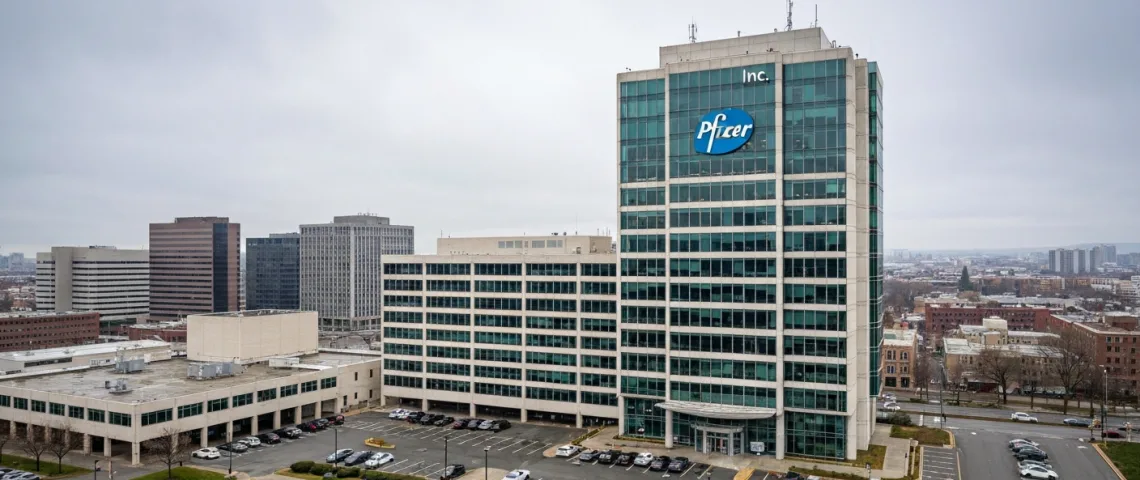
Pfizer shares closed at $26.17 Friday, up 2.23% on volume 25% above the 30-day average. Not a breakout. But for a stock that’s been stuck in a $25-$28 range for months, the action caught the attention of traders scanning for a catalyst shift.
The fundamentals tell a more interesting story than the sideways chart. Revenue grew 5.4% year-over-year to $63.3 billion, driven by non-COVID products. Gross margin sits at 74.8%, and operating margin at 31.6% — numbers that most industrial companies would kill for. Free cash flow hit $12.4 billion, giving the company plenty of room to service its $64.7 billion in debt, much of it from the Seagen acquisition.

Here’s the thing: Pfizer’s trailing P/E is 19.98, roughly in line with the pharma sector. But its forward P/E is just 9.22. That discount implies the market is baking in a steep earnings decline — probably from fading COVID sales and looming patent expirations on Eliquis and Ibrance starting in 2026-2028. The question is whether that pessimium is already priced in.
Technically, the stock is range-bound. Support sits at $25.20-$25.30, resistance at $27.50-$28.00. RSI is neutral at 53. The stock is above its 20-day moving average ($25.77) but still below the 50-day ($26.44). The volume spike on Friday suggests some institutional accumulation, but the trend is not confirmed until it clears $26.44 on strong volume.
News this week gave bulls something to talk about. At the ASCO annual meeting, Pfizer presented over 40 oncology abstracts, including three Phase 3 trials that led to simultaneous journal publications. The BREAKWATER trial, for example, supported FDA full approval of BRAFTOVI in combination with cetuximab and chemo for BRAF V600E-mutant metastatic colorectal cancer. Oncology chief Johanna Bendell called the data a potential new standard of care. Separately, the company launched the SOLIS-1 obesity trial and sold its Haleon stake for $3.2 billion, netting a $2.1 billion after-tax gain. That cash helps pay down debt and maybe even buy back stock.
The bear case is real: Eliquis and Ibrance face patent cliffs, and COVID product sales are still shrinking. But with an EV/EBITDA of 7.9 vs. the pharma average of ~15, Pfizer already trades like the bad news has happened.
Key Takeaways
Strengths
- Forward P/E of 9.2 vs. pharma sector average of ~15
- Free cash flow of $12.4 billion supports debt paydown and reinvestment
- Deep oncology pipeline with multiple Phase 3 readouts at ASCO 2026
Challenges
- Patent expirations on Eliquis and Ibrance post-2026
- Elevated debt from Seagen acquisition limits flexibility
- Declining COVID product sales add revenue headwinds
Analyst Note
Pfizer's forward P/E of 9.2 and EV/EBITDA of 7.9 are deeply discounted versus the pharma sector. The $12.4 billion free cash flow, plus the $3.2 billion from the Haleon stake sale, give management artillery to reduce debt and invest in pipeline. Risks from patent cliffs are real but appear priced in. For long-term investors, the risk/reward skews positive at current levels — especially if oncology and obesity programs deliver. Rating: 4.0/5.
This article is for informational purposes only and does not constitute financial advice, investment advice, or a recommendation to buy or sell any security. BullReader has not received any compensation from the companies mentioned in this article. Always conduct your own research and consult a qualified financial adviser before making investment decisions.
