Fermi Inc. (NASDAQ: FRMI) shot up 22.6% Tuesday on volume hitting 3.5 times the 30-day average. For a stock that’s down almost 70% from its 52-week high of $36.99, that sounds like a turnaround. It’s not. Not yet anyway.
This newly incorporated REIT — barely five months old — is building power campuses for AI customers. It has zero revenue. Zero margins. Zip. Negative earnings per share of -$1.14. The only number that stands up and screams is debt-to-equity: 43.4. That’s not leverage. That’s structural risk.

The balance sheet shows $207.5 million in cash against $465 million in debt. Current ratio of 1.274? Adequate. But that debt pile will come due long before the first AI chip draws power from a Fermi campus. Refinancing risk is real.
Forward EPS sits at 0.365 — the Street is pricing in a textbook turnaround to profitability. But that forward P/E around 18.9x buys you nothing today but speculation on Project Matador and the ‘Fermi 2.0’ strategy unveiled in early May. That strategy hinges on nailing down government-backed loans and permits for a nuclear-powered data center buildout. It’s a moonshot, not a layup.
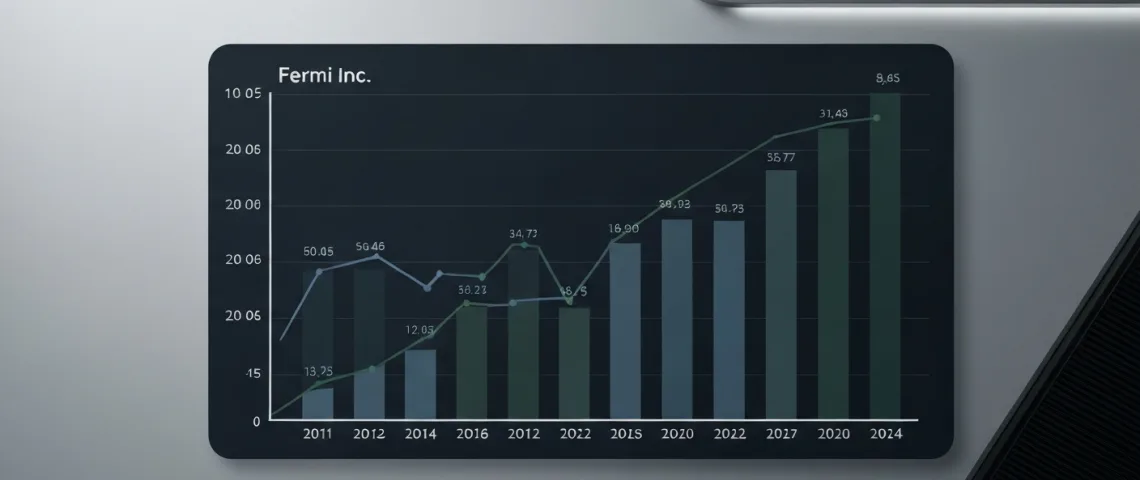
The chart tells a darker short-term story. Price is below both the 20-day ($6.26) and 50-day moving averages. The RSI at 45.6 is dead neutral — no divergence, no exhaustion. The sharp bounce from March lows formed a textbook bear flag, and Tuesday’s surge hasn’t cleared that pattern. Volume on down days is still heavier than on up days. The technician’s call is a sell until we clear $6.50 resistance. Support sits at $5.00-$5.10. If that cracks, the next stop is the March lows near $4.47.
News cycle isn’t helping. On May 15, co-founder and CEO Toby Neugebauer resigned — stock got cut in half in a single session. The board says it’s searching for a permanent replacement. That creates a leadership vacuum at exactly the worst time. The Q1 report and ‘Fermi 2.0’ rollout tried to calm the waters, but without a CEO holding the megaphone, those messages hit softer.
Analysts I’ve spoken to are split. The bulls point to the secular AI infrastructure story: data center demand is real, power constraints are real, and the government is writing checks for this stuff. The bears stare at the debt, the lack of revenue, and the CEO-shaped hole. One sell-sider told me off the record: ‘This is a call option on nuclear permitting. If it works, you make a fortune. If it doesn’t, you lose everything.’
Tuesday’s volume spike could be short covering or a dead-cat bounce. Either way, the fundamentals and the chart agree: wait for a clear entry. That means a break above $6.50 with volume, or a capitulation washout below $5.00. Buying here is gambling, not investing.
Key Takeaways
Strengths
- High-growth AI and HPC infrastructure demand is secular and deep-pocketed
- Positive forward earnings expected by consensus
- Large market cap for a pre-revenue company signals institutional patience
Challenges
- No revenue, no margins, and an unproven business model
- Debt-to-equity of 43.4 is extreme for a development-stage company
- CEO vacancy introduces leadership uncertainty during critical construction phase
Analyst Note
Fermi Inc. remains a high-conviction speculative vehicle for AI infrastructure, but near-term execution risk is amplified by the CEO departure and elevated leverage. The stock could double from current levels if Project Matador secures financing; it could also halve if the next debt payment triggers a liquidity crunch. Neutral for now, with a strong bias toward waiting for a clearer technical or fundamental catalyst.
This article is for informational purposes only and does not constitute financial advice, investment advice, or a recommendation to buy or sell any security. BullReader has not received any compensation from the companies mentioned in this article. Always conduct your own research and consult a qualified financial adviser before making investment decisions.